
Based on the implementation experience of the MDGs, a number of value added changes have been made while designing the…
The Post-2015 Agenda and its Implementation Challenges: A View from the South
By  2019-02-25T22:21:45+00:00July 28, 2015|
Based on the implementation experience of the MDGs, a number of value added changes have been made while designing the…
In the context of the post-2015 development, every country is expected to work towards achieving the SDGs through various programmes.…
[row][third_paragraph] 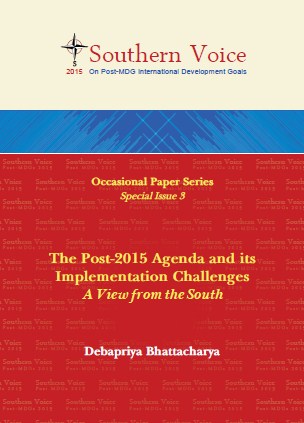 [/third_paragraph][paragraph_right]
The Post-2015 Agenda and its Implementation Challenges: A View from the South
Southern Voice Occasional Paper: Special Issue 3
[/paragraph_right][/row]
Based on the implementation experience of the MDGs, a number of value added changes have been made while designing the…
In the context of the post-2015 development, every country is expected to work towards achieving the SDGs through various programmes.…
Based on the implementation experience of the MDGs, a number of value added changes have been made while designing the…
In the context of the post-2015 development, every country is expected to work towards achieving the SDGs through various programmes.…
Mexico is highly exposed to natural hazards such as earthquakes, hurricanes, and extreme rainfall, with climate change further intensifying these risks. Disasters often have unequal impacts, with women, girls, indigenous and the LGBTQI+ population facing heightened vulnerability due to structural inequalities, limited access to economic opportunities, exposure to violence, and the disproportionate burden of caregiving responsibilities. Despite evidence of these differentiated effects, there is still a lack of comprehensive data to fully capture their scope and duration. At the same time, Mexico is at a pivotal moment with the current administration prioritising gender equality and the National Centre for Disaster Prevention (CENAPRED) preparing its first National Strategy for Integrated Disaster Risk Management (ENGIRD). This creates a unique opportunity to embed gender and intersectional perspectives into disaster policy and practice.
ETHOS’ efforts are geared toward strengthening women’s resilience to disasters in Mexico, particularly hurricanes, through the mainstreaming of gender in the ENGIRD. This will enable women to better prevent, respond to, and recover from disasters. The project assesses the distinct impacts of disasters on women, adolescents, and girls, with a focus on hurricanes affecting Acapulco, Guerrero. It also equips decision-makers with practical recommendations, drawing on evidence gathered through in-depth interviews and surveys. Ultimately, the project seeks to generate gender-disaggregated data on disaster impacts to inform specific action lines within the ENGIRD, and to guide future policy development.
For more information, please visit:
In Latin America, caregiving has long been undervalued, with women carrying most of the responsibility both within households and in paid care roles. Despite the sector’s scale, working conditions are often poor, and opportunities for professional growth remain limited. Regional care agendas have therefore prioritised reducing the burden on women, redistributing caregiving tasks, and revaluing care work by transforming it into dignified, well-paid employment. Within this framework, Early Childhood Education and Care (ECEC) programmes are particularly important, as they shape children’s development while relying heavily on women caregivers. Strengthening certification systems in this workforce offers a pathway to increased recognition, professionalisation, and improved quality of care.
For this project, the Grupo de Análisis para el Desarrollo (GRADE – Perú) and the Fundación para el Avance de las Reformas y Oportunidades (FARO – Ecuador) teams are working to enhance recognition of female caregivers’ critical roles, improve their working conditions, and expand certification programmes to create pathways to decent employment and career growth. The project contributes to regional knowledge by providing evidence on caregivers’ perspectives regarding the value of certification for their employment and well-being. It also offers a comparative analysis across Peru, Uruguay, and Ecuador, examining the characteristics, achievements, and obstacles of skill certification processes in ECEC programmes. By engaging stakeholders and disseminating findings across these countries, the project embeds a gender-sensitive approach into certification, aiming not only to improve care quality, but also to support women’s educational and professional trajectories.
Project video: https://drive.google.com/file/d/1fuSEpdHRnUVo3DTaNN6fGR4-59Q_bF3t/view?usp=sharing
Across Senegal, women entrepreneurs play a vital role in driving innovation, creating jobs, and supporting communities. Yet, their potential remains constrained by systemic barriers that make it harder to start and grow businesses.
Challenges such as limited access to finance, markets, and professional networks, alongside entrenched social norms, continue to limit opportunities. Recognising this, the Government of Senegal has placed women’s entrepreneurship firmly on the national development agenda, seeking to strengthen existing support systems and craft more responsive policies. Initiative Prospective Agricole et Rural (IPAR – Senegal)’s efforts are geared towards strengthening the economic empowerment of women entrepreneurs in agriculture and other sectors in Senegal, through the implementation of supportive public policies informed by data. IPAR researchers have been working to understand with precision 1) the profile of women entrepreneurs in Senegal, particularly in agriculture, and 2) the systemic barriers they face, and their needs in terms of entrepreneurial development (such as financing, training, access to markets etc). Collaborating closely with the relevant government stakeholders, the team aims to inform the implementation of the country’s strategy in favour of entrepreneurship.
In rural Guinea-Bissau, women play a central role in both household responsibilities and agricultural labour, particularly in the cashew sector, which drives the national economy. Yet, their productivity and economic empowerment are constrained by the heavy burden of unpaid care work and by the scarcity of childcare services. During harvest seasons, women often bring young children to the fields, affecting both their work and their children’s safety. This project explores an innovative childcare model tailored to rural realities, and designed to free women’s time, support their livelihoods, and strengthen early childhood development. By linking gender equity with economic productivity, the initiative aims to generate lasting benefits for both families and communities.
The Bissau Economics Lab (BELAB) team is working to reduce the time women in rural Guinea-Bissau spend on unpaid care work, while increasing their economic productivity and income. By expanding and improving childcare provision, the project also aims to strengthen children’s health and cognitive development. To this end, the team is piloting an extended preschool day to assess its effects on children’s attendance, women’s time use, mental health, and employment. They are also testing implementation strategies and identifying factors that enable or hinder effective early childhood development programmes. Ultimately, the project contributes to global knowledge on rethinking childcare in low-resource rural areas, particularly where agricultural demands shape daily life.
Science, technology, engineering and mathematics (STEM) education is essential for nurturing future-ready talent and opportunities in a digital and technology-driven economic landscape. It is a cornerstone of the country’s “Golden Indonesia” vision to build strong human resources and foster innovation to drive sustainable development. However, persistent gender disparities remain. While many women pursue higher education, they are less likely to choose STEM fields or continue into STEM careers.
This gap is shaped by a combination of factors, including cultural expectations, limited early exposure to STEM subjects, and the perception that these fields are traditionally male-dominated. Schools play a crucial role in shifting this narrative and encourage more girls to pursue and excel in STEM-related subjects.
This project seeks to advance gender equity in STEM education in Indonesia. Center for Indonesian Policy Studies (CIPS) researchers are working with secondary school leaders to encourage female student interests and achievements in STEM subjects in order to increase more women to join STEM fields at the higher education level; while also contributing to the existing body of knowledge on gender equity within the country.
By engaging with local governments, school teachers, and consulting gender experts, the team aims to uncover the root causes of underrepresentation, map and identify barriers to entry, and develop practical teaching guidelines for gender-sensitive educational instruction in secondary school classrooms. The project envisions a future where teachers actively integrate gender-responsive learning principles into their classroom materials, and government staff at all levels prioritise and support schools in adopting gender-sensitive approaches that foster more girls and women enter into STEM fields.
Politics in Pakistan has long been considered a male-dominated sphere, despite women comprising nearly half of the population. Globally, women hold only about a quarter of political positions, and in Pakistan, their representation within party decision-making structures is even more limited.
While quotas have helped increase the number of women in parliament, their voices within party leadership remain minimal. Women’s divisions within parties are often inactive and guided by male-dominated agendas, leaving women sidelined from the very spaces where key decisions are made. Addressing this political inequality, which sits at the root of many other gender gaps, is therefore critical.
This Sustainable Development Policy Institute (SDPI) project aims to foster a more gender-equitable political environment by advocating for increased representation of women in party leadership and in decision-making. Through research, policy briefs, and media advocacy, it will highlight the barriers women face and propose concrete reforms to strengthen their roles.
Knowledge-sharing platforms such as consultations, workshops, and partnerships with parliamentarians, civil society, and women’s rights bodies will help build consensus. The ultimate vision is to secure legislative change that institutionalises women’s voices within political parties, paving the way for more gender inclusive governance in Pakistan.