
Climate change in Uganda disproportionately affects women and girls, deepening existing inequalities through displacement, food insecurity, health risks, and unpaid…
COP31: The Cost of Excluding Women from Climate Decisions
By  2026-11-25T17:45:20+00:00November 25, 2026|
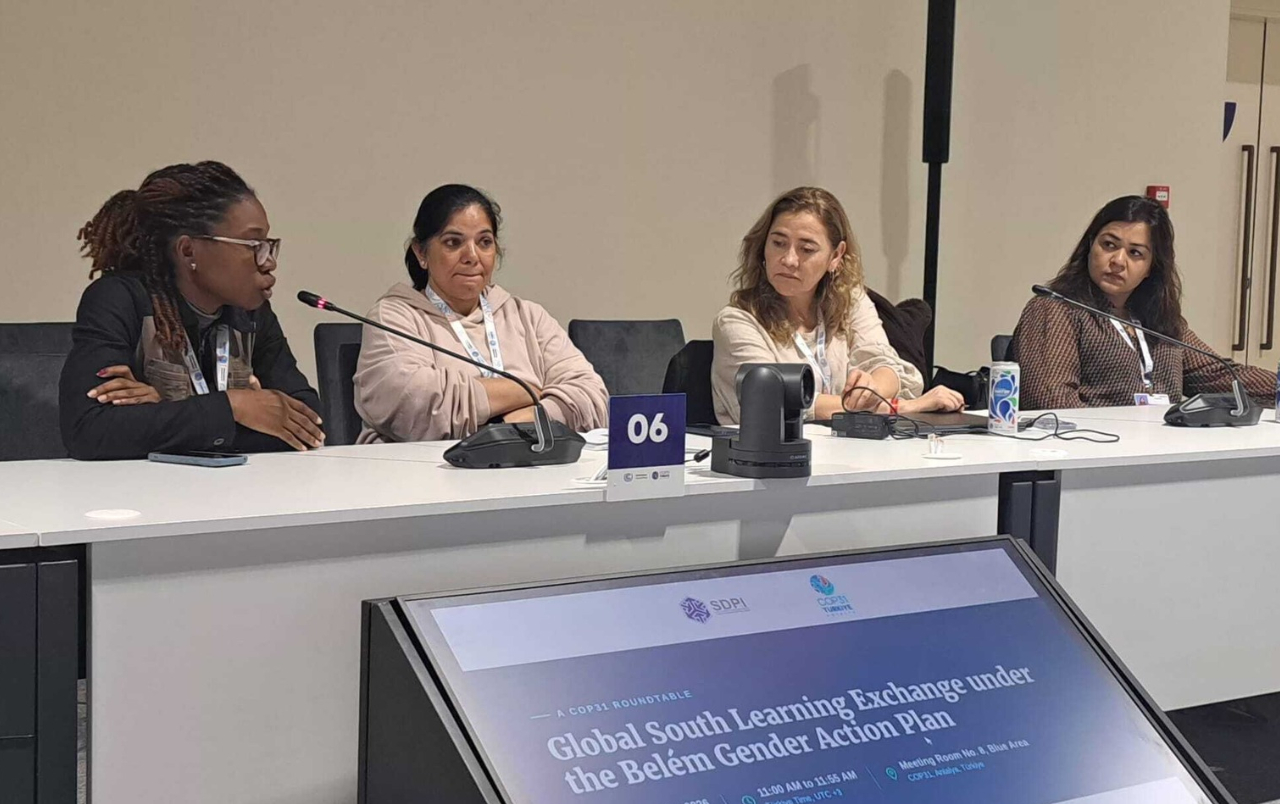
At the COP31 roundtable on the Belém Gender Action Plan, women’s interventions sharpened the question behind my own contribution on energy. How can climate policy respond to women’s lives if they have limited influence over decisions, and if the losses they bear remain poorly documented?
Four lessons stood out: education must strengthen women’s agency; participation must carry decision-making power; local evidence must reach national policy; and public investment must consider the costs of exclusion.
The Belém Gender Action Plan, adopted at COP30 for 2026–2034, connects gender equality with leadership, climate finance, technology and accountability. The discussion brought those commitments into practical focus.
Education that strengthens agency
Education can help women interpret information, negotiate and influence policies affecting their livelihoods. This includes schooling, technical training and access to information about rights and finance. UNESCO’s 2026 review highlights how educational disadvantage varies with poverty and location, even where national averages suggest progress.
A woman’s right to be heard does not depend on formal qualifications. Women already hold knowledge about farming, markets, care and environmental change. Education should expand their choices, while institutions recognise the expertise they bring.
For energy programmes, this means connecting training to opportunities to use and control technology. A young woman trained in solar installation needs access to equipment and paid contracts. Programme success should depend on whether she can apply her skills and influence the conditions of her work.
Authority over investment decisions
The second lesson concerns authority. Representation in a meeting tells us little about who sets priorities or controls a budget. Women’s participation should influence which investments proceed, how resources are allocated and how results are assessed.
My intervention used energy as a concrete example. For a woman processing agricultural produce, an electricity connection may still leave an essential machine unaffordable or operationally unreliable. Useful investment begins with the productive activity and the constraints its users identify.
Local planning should therefore involve women producers and traders early enough to shape technology choices and funding decisions. Authorities should explain which proposals they accept and why. Childcare, accessible information and suitable meeting times can make participation feasible. Men and boys also have a role in sharing care responsibilities and changing rules that restrict women’s choices.
Local evidence that reaches national policy
This lesson concerns evidence availability to decision-makers. Household totals and national averages can conceal differences in losses, access to resources and recovery. UN Women highlights the importance of data disaggregated by sex, age and disability, alongside qualitative evidence on gender roles and control over resources.
An energy connection, for example, does not reveal who can use it for paid work. A disaster assessment recording damaged buildings may miss interrupted informal businesses or additional unpaid care. Surveys need to capture these experiences and include differences among women themselves.
Evidence must also travel. A practical route would connect community organisations and local authorities with national statistical offices, sector ministries and climate planning teams. Think tanks can help develop comparable indicators and analyse findings without losing local detail. Communities should receive feedback on how their evidence affects decisions.
South–South exchange can support this work. Research commissioned by UN Women in Guatemala combines time-use surveys with spatial environmental data to examine overlapping time and income poverty. Its relevance elsewhere lies in the method, which countries can adapt to their own circumstances.
Counting the costs that budgets overlook
The final lesson asks public policy to examine what exclusion costs. Interrupted schooling can narrow future opportunities. Unreliable energy can halt production and spoil goods. Additional care responsibilities can reduce time available for education, rest or paid work.
These consequences require different measures. Business assessments can track income lost during interruptions and the cost of damaged stock. Time-use surveys can document unpaid workloads. Education monitoring can identify missed school days and reasons for leaving. Health, safety and agency also need attention, including where monetary valuation would be inadequate.
Cost estimates should state their assumptions and distinguish observed losses from opportunities that might have materialised under different conditions. Analysts should avoid counting the same loss twice. Time saved cannot automatically be treated as additional earnings.
Women’s rights to education and participation apply independently of any financial return. Economic evidence can additionally help governments assess the consequences of underinvestment and direct resources towards the barriers women identify.
Putting Belém into practice
Together, these lessons suggest a practical agenda for implementing Belém: fund the capabilities women need, give them influence over investment, and connect evidence on their circumstances to public budgets.
In Cameroon, The Okwelians is experimenting through its ORCA Coalition with a participatory approach to local value chains. It brings public institutions, businesses and civil society into discussions about concrete territorial problems. This offers a setting to test how women’s priorities can inform projects and national policy. A durable mechanism linking local consultations to national decisions still needs to be built.
Governments and climate funders should resource that work, including community consultation, local data collection and analysis by capable civil society organisations and think tanks. Monitoring should track women’s influence over decisions and the outcomes they value, such as continuity of income, time available for learning and control over productive assets.
The lesson I take from the women who spoke alongside me is a demand for institutions to act on what women know. Belém’s implementation should be judged by whether its priorities change investment decisions and whether the losses and constraints it identifies receive an effective response.