
Southern Voice and Partners Publish Policy Brief Series for 1 For 8 Billion Campaign
By  2026-05-18T15:53:06+00:00May 18, 2026|
Most debates about the next United Nations Secretary-General focus on candidates: who is gaining support, who appears politically acceptable, and who might secure backing inside the Security Council.
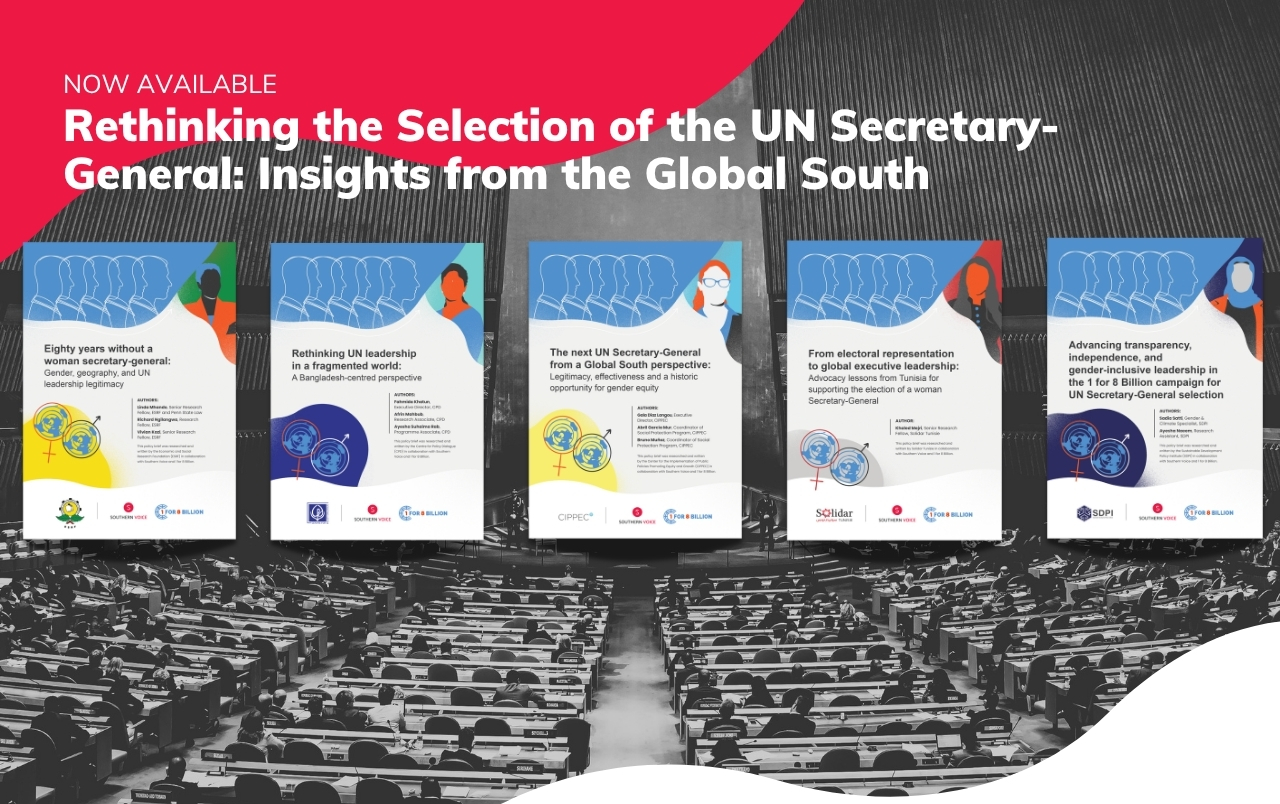
Southern Voice and its partners have published a series of policy briefs titled “Rethinking the Selection of the UN Secretary-General: Insights from the Global South” as part of the 1 for 8 billion campaign. The series looks at a different question: the structures that shape viability long before the process becomes public.
Drawing on interviews, civil society consultations, electoral evidence, and national political experience, the series examines how leadership pathways are shaped inside multilateral systems, and why some profiles still move through them more easily than others.
Leadership, Legitimacy, and Institutional Effectiveness
Across the five briefs, one idea comes through clearly: the debate is larger than whether the United Nations should finally appoint a woman Secretary-General.
All the countries covered in the series have already had women in senior national leadership roles. As a result, the discussion emerging across the briefs moves beyond symbolic representation or the idea that “it is time” for a woman Secretary-General. Instead, the contributions focus on how leadership diversity shapes institutional legitimacy, international credibility, and the UN’s ability to respond effectively to increasingly complex global crises.
Several contributions argue that the continued exclusion of women from the UN’s highest office reflects structural barriers that narrow the range of leadership profiles recognised by the system. The deeper question is what kinds of experience, leadership trajectories, and institutional authority remain undervalued within multilateral institutions.
Another strong common thread is that political viability is often constructed long before formal evaluation begins. Nomination practices, diplomatic sponsorship, informal networks, and early diplomatic signalling still shape which candidates are perceived as credible or acceptable before the wider debate becomes visible. In practice, these dynamics tend to disadvantage women candidates from the outset, long before any formal assessment of qualifications or leadership capacity takes place.
Grounded National Perspectives
Each brief approaches the issue from a distinct national and regional perspective.
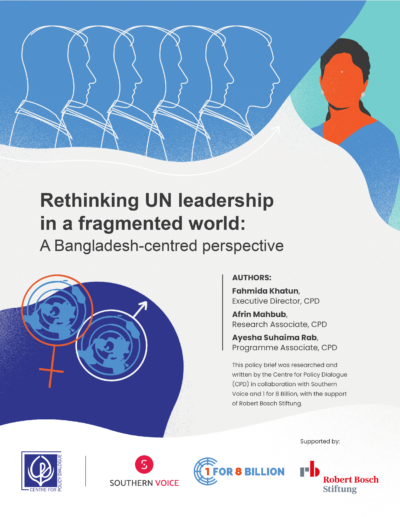
In Bangladesh, the Centre for Policy Dialogue (CPD) draws on consultations with civil society organisations and the country’s experience with peacekeeping operations and humanitarian pressures to reflect on what effective UN leadership requires in moments of crisis.
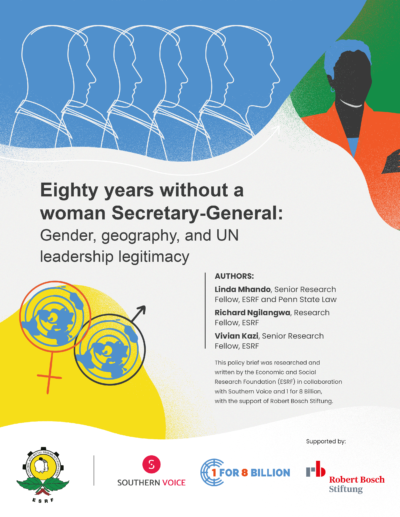
Tanzania’s Economic and Social Research Foundation (ESRF) connects gender and geographic representation to institutional legitimacy, particularly at a time when many of the UN’s operational responsibilities remain concentrated across Africa and the wider Global South.
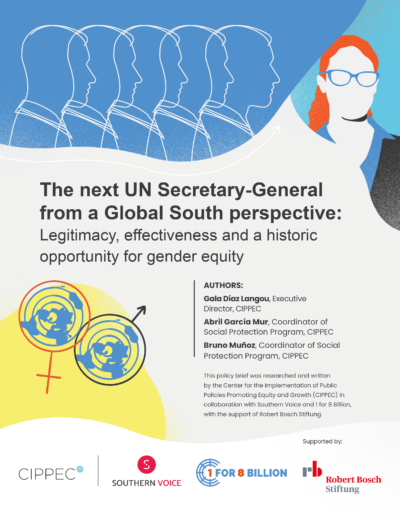
The Centro de Implementación de Políticas Públicas para la Equidad y el Crecimiento (CIPPEC) from Argentina, argues that the legitimacy of the next Secretary-General will depend not only on the final appointment, but on the fairness and openness of the process itself. The brief also examines how informal negotiations, concentrated power, and upstream diplomatic filtering still tend to reward “safe” candidacies long before the wider UN membership enters the conversation.
In Pakistan, the Sustainable Development Policy Institute (SDPI) examines how opaque negotiations and long-standing structural barriers shape women’s access to leadership positions. It also highlights the role elected members of the Security Council can play during the selection process, particularly in opening space for broader conversations around candidates and priorities.
Finally, Solidar Tunisie uses Tunisia’s post-2011 political trajectory to show how formally neutral systems can keep reproducing exclusion when access to leadership depends on gatekeepers, informal networks, resource asymmetries, and socially coded expectations around authority and credibility.
What Comes After the Appointment
A further theme emerges across the series: the question does not end with who becomes Secretary-General.
Several briefs point to the wider ecosystem surrounding the role, including senior appointments, coalition-building dynamics, and the distribution of authority inside the UN system. The concern is whether leadership structures reflect the realities the organisation is expected to address.
Taken together, the five briefs offer a broader reflection on the kinds of leadership multilateral institutions still struggle to recognise, especially when those experiences come from outside traditional centres of power. Collectively, the research makes a stronger case for rethinking the leadership profiles the UN system continues to reward, and the kinds of political authority it increasingly needs to respond effectively to today’s global challenges.
The series was developed through Southern Voice’s collaboration within the 1 for 8 Billion campaign, with editorial and design support from Plataforma CIPÓ. Readers can access the full Synthesis Report, which brings together the main findings emerging across the five briefs, as well as the individual publications with country-specific analysis and recommendations on this page.